

What Is a Confirmation Candle? A Guide to Confirmation Candle Trading
If you have ever entered a trade the instant price tagged your level, only to watch it slice straight through, you have already met the problem that confirmation candle trading is built to solve. A confirmation candle is the market's way of saying "I tested this level and I am done testing" — and learning to read it separates reacting to a wick from responding to a decision. This guide walks through what a confirmation candle actually is, why the close matters far more than the touch, what a clean one looks like at a Fibonacci level, and the exact rule for where you enter once you have it.
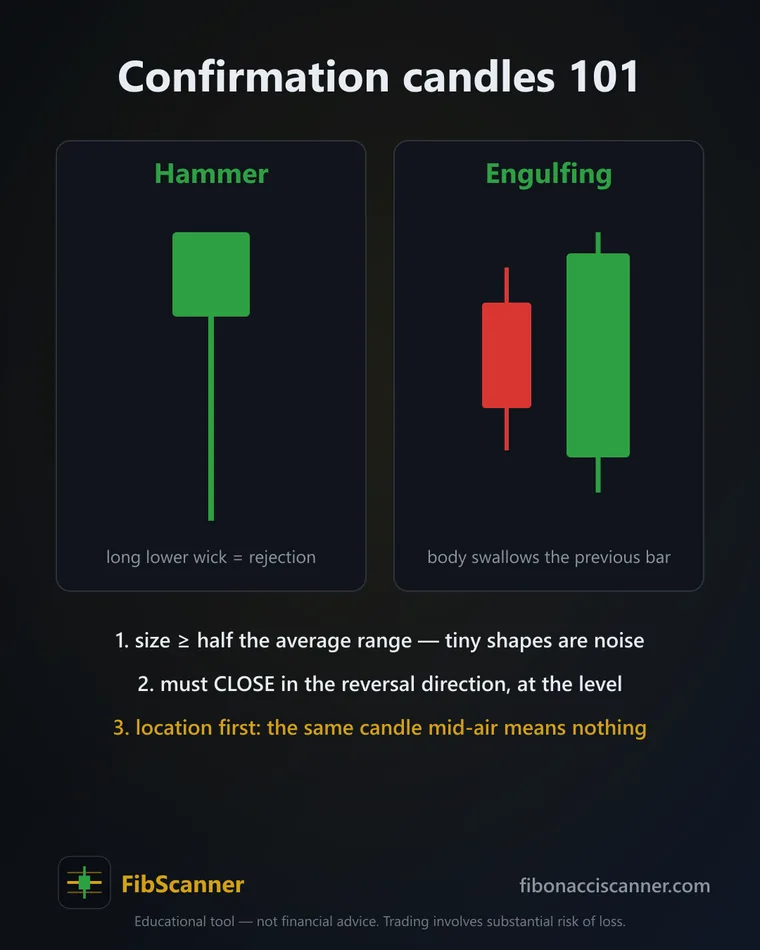
What is a confirmation candle?
A confirmation candle is a completed candle that shows price accepting or rejecting a level, closing in the direction you want to trade rather than merely touching the level with a wick. It is the difference between "price reached my zone" and "price reached my zone and buyers/sellers responded." You act on the second, not the first.
Think of any support or resistance level — a moving average, a prior high, a Fibonacci retracement — as a line in the sand. Price visits that line constantly, and most visits mean nothing. A wick that pokes through and snaps back could be a stop-run, a spread spike, or one large order absorbed in seconds. A confirmation candle asks for more: it wants the body of a finished candle to settle where you expect, on a timeframe you chose in advance. That completed body does not predict the future, but it tells you that when the market had a full candle to decide, it decided in your favour.
Two common shapes qualify:
- A rejection close — a long lower wick with the body closing back above support (or a long upper wick closing back below resistance). Classic hammer / pin-bar behaviour.
- A reclaim close — a strong-bodied candle that closes decisively back through the level after price dipped beneath it.
Both share one non-negotiable trait: the candle must be closed before it counts.
Why wait for the close instead of the touch?
Because an unclosed candle can still become anything. A wick is provisional; a close is final. Until the candle completes, the "confirmation" you think you see can be erased by the next tick, and acting on it means trading a picture that no longer exists a minute later.
This is the single most expensive habit in retail trading. Price drops into your zone, a green candle starts forming, and the fear of missing out pulls the trigger early. But mid-candle that green body can hollow out into a bearish close, and now you are long into continued selling. The touch tempted you; the close would have kept you out. Waiting also filters the exact trap that hunts stops: a fast wick beneath support that reverses hard. If you enter on the touch, that wick fills you and stops you in the same breath. If you wait for the close, the reversal is your signal instead of your loss.
Here is the trade-off, stated plainly. Waiting for the close means you never get the absolute lowest tick, and occasionally price runs without ever giving a clean confirmation — you miss it. That is the cost. What you buy with it is a decision made on completed information instead of a hopeful guess mid-formation. This is also why serious tooling reads only closed candles: a signal that can change after the fact is not a signal, it is a suggestion. That discipline is exactly why a well-built scanner does not repaint — the call it logged is the call it made.
What does a valid confirmation look like at a fib level?
A valid confirmation at a Fibonacci level is a candle whose body closes inside the retracement zone — roughly the 45–66% pullback, centred on the 50% level and the golden pocket — in the direction of the original impulse. The wick may pierce deeper; the body is what has to hold.
The golden pocket is the 0.618–0.65 retracement zone where a pullback most often finds support in a trend, and the 50% level is the intuitive midpoint of the move — together they form the area professionals watch. But the level alone is not a trade. A wick that stabs into the golden pocket and closes well below it is telling you the level failed, not held. What you want is context plus commitment: a genuine impulse leg first, a pullback into the zone, and then a candle that finishes inside or reclaiming the zone. For the full mechanics of why this zone matters, see our breakdown of the 50% retracement strategy.
A quick reference for what earns the label:
| Trait | Confirmation ✅ | Not confirmation ❌ |
|---|---|---|
| Candle state | Fully closed | Still forming |
| Where the body sits | Closes in / reclaims the zone | Closes beyond, rejecting the zone |
| Signal source | The close | A wick touch only |
| Context | Follows a real impulse leg | Random tag in a chop |
How does confirmation candle trading time your entry?
You enter on the break of the confirmation candle — a stop or trigger just beyond its extreme in your trade direction — so the market has to continue the move before you are committed. The confirmation candle proves the level held; its break proves momentum is following through.
Concretely, for a long: your entry sits a few ticks above the confirmation candle's high. Price has to trade up through that high to fill you, which means you are only in once the reversal is extending, not merely hoping. Your stop goes below the confirmation candle's low — ideally ATR-floored just under the spike, so normal noise does not clip you but a genuine failure does. And because you entered from a defined zone rather than mid-air, a natural target sits at the 1.618 extension of the original leg, which lets you judge the risk-to-reward before you commit rather than after. This "close in the zone, enter on the break, stop under the spike" sequence is the backbone of a repeatable setup — we cover the full checklist in trade setup mechanics.
That is the whole logic chain: a closed body in the zone earns your attention, the break of that body earns your entry, and the spike below it defines your risk.
One genuine aside on doing this across 293 markets
Reading a single confirmation candle on one chart is straightforward. Doing it patiently across dozens of markets and eight timeframes, at every hour, without staring at screens, is not — you simply cannot watch that many charts, so the good closes happen while you are asleep or working. That is the entire reason FibScanner exists: it watches 293 markets across 8 timeframes and only alerts you when a candidate has actually closed its confirmation at the level, so you review a formed setup instead of babysitting live wicks. The free tier runs the full engine on one market and one timeframe with no card, if you want to see the closed-candle logic work before committing to anything.
Frequently asked questions
Does a confirmation candle guarantee the trade will work?
No. A confirmation candle improves the quality of your evidence — it tells you a level held on a completed candle rather than a fleeting wick — but no candle removes the possibility of a losing trade. It is a filter for better decisions, not a promise about outcomes, which is why a predefined stop and a risk:reward worth taking matter just as much as the signal itself.
Which timeframe should the confirmation candle close on?
Whichever timeframe you defined your setup on — and pick it before you are in the trade, not after. A confirmation on the 4-hour carries more weight than one on the 1-minute, but a lower timeframe gives you a tighter stop. The mistake to avoid is "timeframe shopping" after entry, hunting for any chart that agrees with a position you already hold.
Is a wick touch ever enough on its own?
Rarely, and never as your default. A pure wick touch with no closing body behind it is exactly the pattern that stop-runs exploit. If you find yourself justifying an entry on a wick alone, that is usually the moment to wait for the candle to close and let the market show its hand.
What is the difference between a confirmation candle and a reversal candle?
They overlap. A reversal candle is any candle whose shape suggests a turn (a hammer, an engulfing candle, a pin bar). It becomes a confirmation candle when it closes at a level you were already watching and completes to trigger your plan. In short: the reversal is the shape; the confirmation is that shape closing where it matters.
