What Is a Trading Scanner and Do You Actually Need One?
A trading scanner is software that continuously watches a set of markets and alerts you when a specific, predefined pattern or setup appears — so you don't have to sit in front of the charts waiting for one. It differs from a screener, which filters a universe by criteria at a single moment in time, and from a price alert, which fires when price reaches a level you drew yourself. Whether you need one comes down to a single question: how many markets do you want covered, and can you personally watch them all? This article explains exactly what a scanner does, what separates a useful one from alert spam, and who genuinely doesn't need one.
What does a trading scanner actually do?
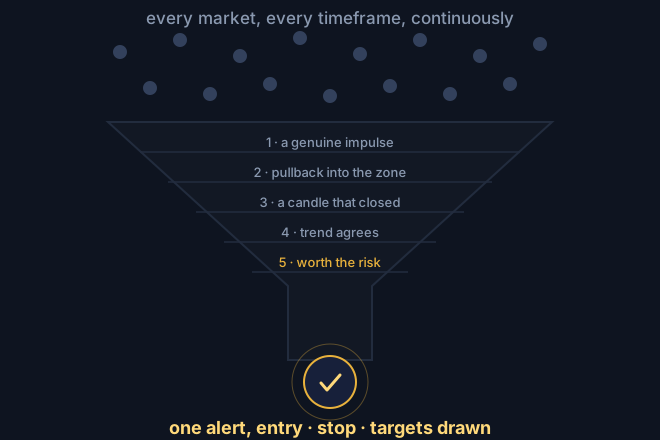
A trading scanner runs three jobs on a loop, continuously, without you: it watches a defined universe of markets across chosen timeframes, it evaluates each one against a set of rules, and it notifies you when the rules are satisfied.
That loop is the whole product. Everything else is detail — which markets, which rules, how it tells you.
The important word is continuously. A scanner has memory and persistence: it was watching that market at 3am when the candle closed, and it will still be watching at 3pm. That's the fundamental difference from tools you have to point at something and run.
What a scanner is not: it isn't a prediction engine, and it isn't a trading robot. It doesn't know what price will do next, and a well-built one doesn't claim to. It finds candidates that match a pattern and hands them to you with the arithmetic already done. The decision stays yours.
Scanner vs screener vs alert: what's the difference?
These three get used interchangeably and they're genuinely different tools:
| Tool | What it does | Time model | Best for |
|---|---|---|---|
| Screener | Filters a universe by criteria and returns matches | A snapshot, right now | Narrowing thousands of stocks to a shortlist |
| Price alert | Fires when price reaches a level you marked | Waits on one level | A small watchlist you analyse yourself |
| Scanner | Watches continuously, evaluates a full setup, alerts when complete | Ongoing, with memory | Covering more markets than you can watch |
The practical distinction: a screener filters, an alert waits, a scanner watches.
A screener is a question you ask ("which markets are oversold right now?"). A scanner is a standing instruction you leave running ("tell me whenever a complete setup forms anywhere on this list"). If you find yourself re-running a screener every hour and opening the results by hand, what you actually wanted was a scanner.
And a price alert firing tells you price arrived at a level. It doesn't tell you anything happened there — which is why an alert on its own so often leads to a bad entry. A confirmation candle is the difference between "price touched this" and "this level held".
What separates a good scanner from alert spam?
The gap between a scanner worth using and one you'll mute within a week comes down to four properties.
1. It enforces a complete setup, not a single condition. "RSI crossed 30" is one condition. A setup is a structure: a genuine impulse leg, a pullback into a sensible zone, a confirmation that the level held, agreement with the larger trend, and a reward worth the risk. A scanner that fires on one condition will fire constantly, because one condition is met somewhere almost always. The five gates are a reasonable minimum standard.
2. It reads closed candles only. This is the one most people don't check and later regret. A tool that computes on live, unfinished candles can display a signal that disappears when the candle closes — it repaints. The consequence is nastier than it sounds: your backtest fills with signals that were never actually available in real time, and your live results never match. Closed-candle logic means if an alert fired, it fired on completed data, and it will still be there when you open the chart.
3. It is quiet. The instinct is to judge a scanner by how many opportunities it surfaces. Invert that. A scanner sending dozens of alerts a day has a standard so loose that you're the filter again — and you'll do what everyone does, which is start ignoring it. Quiet days are a feature. A scanner that says nothing for two days and then produces one clean setup is doing its job.
4. It shows its working. When an alert arrives you should be able to see why: which level, which candle confirmed, where the stop sits, what the reward-to-risk is. A scanner that just says "BUY SIGNAL — EURUSD" is asking for trust it hasn't earned. You should be able to open the chart and verify every claim it made.
Two red flags worth naming plainly. Be sceptical of any tool marketed with win rates or profit claims — nobody can promise those, and the ones who do are selling the promise, not the tool. And be sceptical of pinned screenshots of winning calls: any tool can show its best day. What matters is whether the logic is consistent and verifiable.
Do you actually need a trading scanner?
Here's the real test. Count the markets you want to be covered on, multiply by the timeframes that matter to you, and ask whether you can personally watch that number all session.
You probably don't need one if:
- You trade one or two markets and know them deeply. Depth beats breadth here, and a multi-chart layout does the job.
- You're a discretionary trader whose edge is context and narrative rather than repeatable chart patterns.
- You're still learning to identify setups by eye. Automating a pattern you can't yet recognise means you can't tell when the tool is wrong — learn the pattern first.
- You trade so infrequently, or on such high timeframes, that a weekly review covers it.
You probably do need one if:
- Your watchlist is bigger than about a dozen markets, or you want it to be.
- You keep discovering good setups after they've played out.
- The markets you trade run while you're asleep or at work — crypto around the clock, or sessions in another timezone.
- You have a repeatable, rules-based setup you could describe to someone else in five bullet points. That's the profile a scanner automates well.
- You're setting so many manual alerts that maintaining them has become a chore.
That fourth point is the real qualifier. A scanner automates a rule, so you need a rule. If your entries are "it looked right", there's nothing to automate, and the right answer is to develop the rule first. Trying to skip that step is how people end up paying for software that alerts them to setups they don't actually understand.
What should you look for when choosing one?
Beyond the four quality properties above, check these before you commit:
- Coverage. Which markets and how many timeframes? Coverage is the entire reason to use a scanner — a scanner watching 20 markets solves a problem you didn't really have.
- Data transparency. Where does the price data come from, and is any of it delayed or a proxy rather than the real instrument? A tool that's straight with you about this is telling you something about how it's built.
- What happens when it's off. If it only scans while your browser is open, that's a real constraint — know it before you rely on it.
- Privacy and account requirements. Does it need an account, and does your watchlist leave your machine? Local-only tools are meaningfully lower-risk.
- A free tier you can test. You should be able to watch the thing work on a market you know well before paying. If you can't try it, be careful.
- Cost against your actual trading. A scanner is a time-saving tool. If the subscription is significant relative to your account, the maths doesn't work regardless of how good it is.
Where FibScanner fits
FibScanner is a scanner in the strict sense above. It watches 293 markets across 8 timeframes — 2,344 chart-views — for Fibonacci-retracement and range-breakout setups, and it only speaks when a candidate clears all five gates: a genuine impulse, a pullback into the zone, a confirmation candle that closed, a trend filter, and a reward worth the risk. Every alert arrives with the entry, stop and two targets already worked out, so you can check its reasoning rather than take it on faith.
It reads closed candles only, so nothing it shows you repaints. It runs entirely on your own machine — no account, nothing leaves your device — as either a Chrome extension or a native Windows app, with one licence key covering both on up to three devices. Alerts fire while the extension or app is running; there's no cloud tier, and we don't claim one.
The free tier runs the complete engine on one market and one timeframe with no card required, which is the sensible way to judge whether any of this is useful to you. If you want the method it applies, that's in the guide — and it's worth understanding whether or not you ever use the tool.
Frequently asked questions
What is a trading scanner in simple terms?
Software that watches a list of markets for you and tells you when a specific setup appears. Instead of you checking charts one by one, it checks them continuously and notifies you when its rules are met.
Is a scanner the same as a screener?
No. A screener filters a universe by criteria and gives you matches at that instant — you run it, you read the list. A scanner keeps watching over time and alerts you when a complete setup forms. Screeners narrow; scanners watch.
Do trading scanners actually work?
A scanner reliably does what it's built to do: watch markets and flag pattern matches. What it can't do is predict outcomes — no tool can. The useful question isn't "does it work" but "does it correctly identify the setups I already trade, without repainting, and without burying me in noise?"
Are free trading scanners any good?
Some are genuinely useful, particularly free tiers of paid tools, which usually give you the full logic on a limited number of markets. Be wary of anything free that pushes signal groups or promises returns — that's a different business model wearing a scanner's clothes.
Will a scanner make my trading profitable?
No, and be cautious of anything suggesting otherwise. A scanner changes how many qualifying setups you see and how much time you spend looking. Whether you trade them well — sizing, risk, discipline — is unchanged and still entirely down to you.
Can a scanner replace learning technical analysis?
It shouldn't. If you can't recognise the setup yourself, you can't judge when the tool has produced a poor candidate, and every scanner produces some. The sensible order is: learn the pattern, trade it manually until you trust your own judgement, then automate the watching.
